Sound is a mechanical wave that is an oscillation of pressure transmitted through a solid, liquid, or gas, composed of frequencies within the range of hearing and of a level sufficiently strong to be heard, or the sensation stimulated in organs of hearing by such vibrations. Wow, that is a long definition as provided by our good folks Internet. I bet nobody understands what that means. Let me explain: Sound is produced when there is vibration in the air or in a particular medium and can be heard if it is picked up by our ears or any tools.
These vibrations are also known as waves, and can vary in frequency. What do I mean by that? The frequency varies by how many times the vibrations take place in a second. The greater the number of times, the higher the frequency, and thus the sound produced will be a higher pitch. This theory applies to lower frequency sounds too. With lower frequency sounds, the number of vibrations in a second are less too, and thus the pitch of the sound is lower. Here's a little picture to give you a clearer picture (what a lame joke):
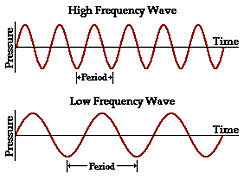
http://www.kenstone6.net/fcp_homepage/images_location_sound/12_location_sound.jpg
Well, sounds are produced in waves, or ripples as some may call it. Sound frequency can also be measured in Hertz, or Hz. Don't confuse that with the clock rate of your computer though they use the same measurement. Hertz simply means cycles per second. Our ears can hear a certain range of sound varying from 20Hz to 20000Hz. Wow, that's a great range. Try out this test to see how good your ears are.
WARNING!!! DO NOT TURN THE VOLUME OF YOUR COMPUTER TOO LOUD. IT MAY DAMAGE YOUR EARS AND THE PRECIOUS SPEAKERS OF YOUR COMPUTER. I AM NOT TO BLAME FOR ANY INJURIES OR TECHNICAL FAULT.
Hmm......I think I am going deaf. And we humans can only produce sounds from 60Hz to about 70000Hz. That sounds rather interesting, but not as interesting as a bat that can produce 120000Hz sound. Ouch, I think my ears is gonna hurt. Oh wait, we can't even hear it.
Now, let us head up to the speed of sound. The speed of sound varies in different mediums, just like light. Here is a formula for it:

http://upload.wikimedia.org/math/2/2/c/22c80ad7ec4e3bfff68f62186a0c2c1c.png
C represents the coefficient of stiffness, or how stiff a particular medium is.
P represents the density of the medium.
Thus, the speed of sound increases with the stiffness of a particular medium. An example will be how sound travels at about 1230km/h in air but travels at about 21460km/h in steel. Wow, that's rather fast.
I believe you guys know that there are planes that travel faster that sound. But that will mean they will have to break through the sound barrier. Sounds confusing? Well, planes that fly faster than sound travels faster than the air can get out of the way. This air builds up in front of the plane like a wall. This is the sound barrier. Once through this wall, or as we know, after breaking the sound barrier, the flight is smoother. Here is an image to show you how breaking the sound barrier looks like:

http://atlasshrugs2000.typepad.com/atlas_shrugs/images/sound_barrier_2.jpg
Well fellow scientists, hope you have an interesting journey into the world of sound. It is sad we don't have experiments to show you, except for the frequency video. Hmm......perhaps next time we shall do some real experiments that is sure to wreck your kitchen. Farewell and have fun!

No comments:
Post a Comment