Monday, August 29, 2011

The Wonders of Light Sticks

Now my fellow scientist of this world. As I speak, there are tons of light shining in my room. But they will soon be turned off and replaced with some other artificial light. To be exact, it is chemical light. To be 'exactess', it is the light stick. The light stick is one of the things in the world that really amazes me. Science revolves around it pretty much, but it is a sad thing that not a lot of people notice them much. It is a common sight at night concerts, at the military, at a diving club. But is there anyone who ever thinks of the chemistry behind it? Well, I shall uncover the 'amazingness' of the light stick to you.


So, how do light sticks work? That is a lot of chemistry. That's right, light sticks work by chemical reaction. Before telling you how it works, I guess it will be necessary for me to tell you the chemicals involved first. First up, we have hydrogen peroxide, followed by phenyle oxalate. Last but not least, a fluorescent dye to give the light its colour. To say it the simple way, the first two chemicals will first mix together to release a whole ton of energy. This energy excites the electrons of the fluorescent dye so much that these electrons go high with energy level and releases light.

For real chemistry crazy fans, I shall give you the exact details: The hydrogen peroxide oxidises the phenyl oxalate ester, to form phenol and an unstable peroxyacid ester. The unstable peroxyacid ester decomposes, resulting in phenol and a cyclic peroxy compound. The cyclic peroxy compound decomposes to carbon dioxide. This decomposition reaction releases the energy that excites the dye which cause them to release light photons.

Okay, that may sound as scientific as you thought, but at least for me, I find it quite enough for my standard of chemistry. To be exact, my head is spinning when I read this. Anyway, I just have this thought, if the world has enough resources to create such chemicals in great abundance, wouldn't it be great if the world can be lighted by light sticks? Currently, light sticks are only used for commercial use during a concert or for use by those goofy adventurers and soldiers. Don't you think it might be better with this light sticks illuminating the whole world? They look more stylish than the ordinary fluorescent light we have in the house (or LED light for those incredibly rich people).

Enough talk here, since I am finding that these light sticks are reminding me of Star Wars. Well, they do look like light sabers. With that, I commence this post to a close, with a video to greet you of course. A better, and much more detailed explanation on light sticks. It even teaches you how to make one.
TRY AT YOUR OWN RISK

Friday, August 26, 2011

Reflection on Scientific Doings: Term 3

Hiya scientist of the Earth. Today, I called you guys over for a little chat. Not really a little chat, but more of a presentation of my experience this term. So, what have I been doing with Science this term?

Well, in this entire term, the topics were mainly physics, or lenses, to be exact. Well, this topic is extremely similar to the topic of light. The thing is, it is all about drawing the light ray and where they will go and stuff like that. Is is mostly about following the rules. That is, there are rules that we must draw a parallel line to the ground towards the lens from the object before bending it down when it reaches the middle of the lens, and then we have to draw a line straight through the center of the lens and out the other side to meet with the first line we have drawn to find out the image's position. Sounds complicated? But that is what Science is about! All theories and stuff. Wonder if there is a better method than just simply memorising the facts and understanding them blindly.

The next topic we had was biology, or sexual reproduction. Aha, I can tell that you are smirking. But then, we are still learning it. Hmm......it appears that we have also learn this in Primary five, but that was a very brief introduction. This time, we are learning it in depth. Yep, we get to know the exact function of the each and different parts of the sexual reproductive system. But nonetheless, it is still complicated in some way. The thing is, there are so many parts and functions to remember, and wow, there is even a schedule for each and every even like the menstruation cycle. Hmm......it may take some time to make full sense of them.

Last but not least, wow, my test went superbly. Guess what? I got 36 out of 40. Man, that is rather unexpected as I was freaking out during the test itself. But I have to admit this mark is no big deal as everybody did just as good.

So far so good. Term 4 is coming soon in a short time and we shall then face the real challenge of our lives. The final year exam shall rip us out. So, got to go off and study now. Or as the students always say, MUG! So long and good luck on your mugging journey!

Monday, July 4, 2011

Cell Walls: An Alternative For Bones

Hey yo to this world of scientist! Today, I just got a real crazy idea that I want to share with you. I have no idea whether it works, but it is worth telling you. Containing it any longer in my head will cause me to burst. Well, today I woke up with Science circling in my head, mostly biology on cells and tissues. When that happened, one weird idea just suddenly sprout out into my mind. I know, I only say it now because I feel it sounded rather ridiculous. The thing is, what would happen if animal cells happened to have cell walls? Oh, and not to forget, chloroplasts!

Think about it, this world would be mad! We would be making food but I wondered what kind of effect will the cell walls have on us. Perhaps we will look rather strong and supported and perhaps we ourselves have a regular shape? Ha ha! I am just joking! But wouldn’t it be great if we could just make our own food? Sure, we still continue to eat however we like, but at least our made food provide us with extra energy. We will just be like a Venus fly trap! Except we don’t trap our food. Now, the cells walls in plants just gives the cells a regular shape and supports the plant.

But how about that in humans? Oh yeah, we have our bones. But some people are born without bones. Perhaps there is away we could extract cell walls and add them to the cells of people who do not have bones? Would that have worked? I don’t have the slightest idea. Maybe we could add cell walls to the cells of old people since they have rather weak bones. With all that, we might not injure ourselves easily and think of all the cash we could have saved from getting sent to the hospital! As they say, a new idea does not always mean more cash spent! Have a good day humanoids!

Monday, May 2, 2011

Sound ~Waves~

Hello scientist, and welcome to this lab of wonders of science. Today, we shall be greeted by waves of sound energy. What is sound, I heard you ask. Well, sound is kind of a complicated topic and element. But luckily, we have the internet to help us. How kind of it to provide us with the definition.

Sound is a mechanical wave that is an oscillation of pressure transmitted through a solid, liquid, or gas, composed of frequencies within the range of hearing and of a level sufficiently strong to be heard, or the sensation stimulated in organs of hearing by such vibrations. Wow, that is a long definition as provided by our good folks Internet. I bet nobody understands what that means. Let me explain: Sound is produced when there is vibration in the air or in a particular medium and can be heard if it is picked up by our ears or any tools.

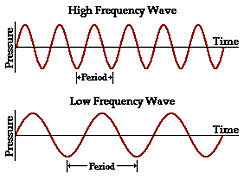
These vibrations are also known as waves, and can vary in frequency. What do I mean by that? The frequency varies by how many times the vibrations take place in a second. The greater the number of times, the higher the frequency, and thus the sound produced will be a higher pitch. This theory applies to lower frequency sounds too. With lower frequency sounds, the number of vibrations in a second are less too, and thus the pitch of the sound is lower. Here's a little picture to give you a clearer picture (what a lame joke):

http://www.kenstone6.net/fcp_homepage/images_location_sound/12_location_sound.jpg

Well, sounds are produced in waves, or ripples as some may call it. Sound frequency can also be measured in Hertz, or Hz. Don't confuse that with the clock rate of your computer though they use the same measurement. Hertz simply means cycles per second. Our ears can hear a certain range of sound varying from 20Hz to 20000Hz. Wow, that's a great range. Try out this test to see how good your ears are.
WARNING!!! DO NOT TURN THE VOLUME OF YOUR COMPUTER TOO LOUD. IT MAY DAMAGE YOUR EARS AND THE PRECIOUS SPEAKERS OF YOUR COMPUTER. I AM NOT TO BLAME FOR ANY INJURIES OR TECHNICAL FAULT.


Hmm......I think I am going deaf. And we humans can only produce sounds from 60Hz to about 70000Hz. That sounds rather interesting, but not as interesting as a bat that can produce 120000Hz sound. Ouch, I think my ears is gonna hurt. Oh wait, we can't even hear it.

Now, let us head up to the speed of sound. The speed of sound varies in different mediums, just like light. Here is a formula for it:

http://upload.wikimedia.org/math/2/2/c/22c80ad7ec4e3bfff68f62186a0c2c1c.png

C represents the coefficient of stiffness, or how stiff a particular medium is.
P represents the density of the medium.
Thus, the speed of sound increases with the stiffness of a particular medium. An example will be how sound travels at about 1230km/h in air but travels at about 21460km/h in steel. Wow, that's rather fast.

I believe you guys know that there are planes that travel faster that sound. But that will mean they will have to break through the sound barrier. Sounds confusing? Well, planes that fly faster than sound travels faster than the air can get out of the way. This air builds up in front of the plane like a wall. This is the sound barrier. Once through this wall, or as we know, after breaking the sound barrier, the flight is smoother. Here is an image to show you how breaking the sound barrier looks like:

http://atlasshrugs2000.typepad.com/atlas_shrugs/images/sound_barrier_2.jpg

Well fellow scientists, hope you have an interesting journey into the world of sound. It is sad we don't have experiments to show you, except for the frequency video. Hmm......perhaps next time we shall do some real experiments that is sure to wreck your kitchen. Farewell and have fun!

Friday, March 11, 2011

Forensic Science? I Doubt It!

Hey yo to this world of renowned scientist again! Today, we have nothing to entertain you except for forensic science! I am sure you guys know what that is. Well, if you have no idea, it is using the science of clues and traces to solve a mystery, like solving a crime case you could said. Well, we learnt this last year but I guess I want to talk about it today. Many scientists are needed for this tedious task. It is said that forensic science is unbeatable as the criminals always left some traces of theirs behind. But here I am to prove you wrong. Well, I am not sure whether it is true but I seem to have some tingling feeling in my mind that tells me there are still flaws in the work of forensic science. So, let’s get started shall we?

Alright, we all knew forensic science mainly uses clues and traces left behind. Things like fingerprints, DNAs and stuff like that. They said fingerprints are superb for identifying suspects but have you ever wondered that fingerprints can be forged? Literally! If you have watched a show called "Mythbusters" you might understand what I meant.

The thing to defeat fingerprints is for the criminal to wear gloves, and if that does not help much, there is always the work of using other people’s fingerprints. How do you do that? Well, first of all you will need some fingerprints(obviously not your own). Brush them out(that’s what the police anyway). Use a kind of material(I have forgotten what it is called) and pour(in liquid form, thats what) them over the prints. The material will dry and harden and now all you have to do is to cut the prints out and put each print on each of you finger. As you see, when you brush out the original fingerprints, it leaves some layer of that print of the surface and when the material is poured over it, it takes the shape of the layer. When it dries, the prints will be forged onto the material itself. It sure works for fingerprint scanners too. So the fact of fingerprinting is always successful is BUSTED.

And now, DNAs. They mainly look for blood and stuff like that which will match the DNA of the suspects. But just imagine, if the criminal were to be in some sort of suit that prevents any bits of him containing his DNA from being left behind, how are they gonna find out? That includes some sort of helmet to prevent any loss of hair at the scene. With this, DNA has been defeated since there is nothing of the criminal being lost and left behind for the scientist ti find out.

And of course, they like to look at foot prints eh? Well, let’s just imagine the soles of the criminal’s shoes have been covered with a layer of material, a bit like rubber. Now, how are they gonna find out? Besides, I wondered how the investigators managed to find out the suspect’s identity merely just by looking at footprints. Do they already have a copy of his footprints before? And if so, wouldn’t the criminal be clever enough to change his shoes? This is getting utterly ridiculous! People getting answers just by looking at something they do not know!

Footprints, fingerprints and stuff like that are getting useless in the help of investigations since they can be easily forged nowadays and even eye-scanners are becoming a laughing stock. This new world of criminals are getting smart and they are smarter than the best detectives and even Sherlock Holmes, though he is just a fictional character. So let me ask you this question: Is forensic science really unbeatable? The answer is: NO!!! I don’t believe there is something so powerful it is never defeated in this world.

Saturday, March 5, 2011

Time Is Terrific!!

Hello again to the world of renowned scienctists. Fancy having more scientific knowledge? Then this blog is for you! Now, the topic. Have you guys ever think about time? No? Then you guys are totally taking things for granted! Time is a complicated thing to study. The most famous person for this job is……Albert Einstein! The renowned scientist(who likes to stick his tongue out) is the first to define time. He says time and space are the same thing and came up with a complicated formula that even now, there are still scientists who don’t understand it. So, what is time? Time is the chronological interval between events measurable by atomic oscillation. Um… pardon me if you don’t understand. Neither do I. Mind you, you need a brain as big as an elephant’s to understand that! Oh, here’s Albert Einstein:


Now, let’s move on. Before time, there was nothing. Absolutely nothing. Not even a speck of atom. Then an explosion occured. It is called the Big Bang and marks the start of time. It is the Big Bang that creates the Universe. Without it, I wouldn’t even be here typing! Space and time are related in some ways. Just imagine time and space as a straightened out carpet that is floating in the air(like the flying magic carpet from "Aladin".) You see, each object in space has mass. The more the mass, the more its pull of gravity. Now, just imagine some balls of different size were put onto the carpet. The one with the most massTim will ‘attract’ the other balls towards it. That is, the smaller balls will gather around the biggest one. That’s rule number one.

Number two. Light is the fastest thing in the world. At a speed of km/h, it can get to the sun in just eight minutes, which is about 150 million kilometres away! The closer you get to the speed of light, the slower time goes. If you are travelling at the speed of light, time ‘freezes’! That’s a I am gonna say for today. Check back next time for more posts on time!

Monday, February 28, 2011

The 'Spacefic' Solar System

Hello people! Now, welcome to my new science blog! Though I used to have one last year, it was on Windows Live Spaces and got deleted since Windows Live wanted to upgrade them to Wordpress. Oh well, I will just start another one. Now, for this post, I will be talking about Astronomy. I know, that sounds lame, but at least it is not as lame as your Primary Five Astronomy. That one is even lamer. So, who wants to hear something?

A Tour Of the Solar System:
The Earth may seem very big to you, but it is just a puny little bit of rock compared to the sun. And the sun is just a tiny little speck of dust compared to the Milky Way. And the Milky Way is just one of a few thirty galaxies that make up the Local Group. And the Local Group is just one of the hundreds galaxies groups in a place called the Virgo Supercluster. To make you feel even more humiliated than before, the Virgo Supercluster is only tiny part of the Universe which still consists of many more other Superclusters. But let's just stick with the Solar System first. We shall go through all the stuff in it, starting with the Sun...

Name: Sun
Size: 1392000 km across
Size compared to Earth: One million times larger
Gravity compared to Earth: 28 times stronger
Length of day: 28 Earth days
Temperatures: Atmosphere known as the Corona is 2 million`C. Surface is 6000`C. Core is 15 million`C!

Wow, the Sun seems blazing from where we are! Better steer clear of it! Let's travel another 58 million km...

Name: Mercury
Size: 4900km across
Size compared to Earth: Three times smaller across
Gravity compared to Earth: About one third
Moons: None
Length of day: 58 Earth days and 12 hours
Length of year: 88 Earth days
Temperatures: During day time is 427`C. At night is -183`C.

Mercury sounds like a place of hell with such a wide range of temperatures. I can't be sure if my luggage would not be full of jackets and if I went there for a vacation night stay. Now, let's move on 50 million km more...

Name: Venus
Size: 12100km across
Size compared to Earth: A bit smaller
Gravity compared to Earth: A little weaker
Moons: None
Length of day: 243 Earth days
Length of year: 225 Earth years
Temperatures: Extreme temperature of 500`C!

I will rather be in hell than to even look at Venus! Okay, it is safe to look at it, but you would not want to think about getting there! All the radiation will kill you right then and there and the acid rain will dissolve what's left of you. Now, I will rather stay on where I am. Hey what do you know? That's where we are going right now...

Name: Earth
Size: 12700km across
Moons: 1, The Moon
Length of day: 24 hours
Length of year: 365.25 Earth days
Temperatures: Hottest recorded is 70.7`C. Coldest recorded is -89.2`C.

The Earth, ahh...the most comfortable planet in the Solar System. No wonder it can sustain life, because of its properties of having the right temperature!

Name: Mars
Size: 6800km across
Size compared to Earth: Half of Earth's diameter
Gravity compared to Earth: A little over one third
Moons: 2, Demois and Phobos
Length of day: 24 Earth hours and 37 Earth minutes
Length of year: 687 Earth years
Temperatures: 30`C

Cool! Mars has been discussed for long of having life and stuff. Hmm...I shall save the best for later. Let's just move down to the next planet...

Name: Jupiter
Size: 140000km across
Size compared to Earth: 1321 times bigger
Gravity compared to Earth: 2.5 times stronger
Moons: 60+, Ganymede, Callisto, Europa, Io etc.
Length of day: 9 Earth hours and 51 Earth minutes
Length of year: 11.8 Earth years
Temperatures: -150`C

Oh man, Jupiter sounds like a wreck! It totally 'outbig' our puny little Earth. Guess what? All of the outer planets 'outbig' our Earth! Let's see how the next one 'outbig' Earth too...

Name: Saturn
Size: 120500km across
Size compared to Earth: 764 times larger
Gravity compared to Earth: About the same. Or 1.16 if you want to know.
Moons: 60+, Titan, Enceladus, Trojan, Hyperion, Mimas etc.
Length of day: 10 Earth hours and 38 Earth minutes
Length of year: 29.5 Earth years
Temperatures: -170`C

Ha! Saturn is smaller than Jupiter! But it is still incredibly big! Aargh! Let's move on to the next one and pray that it won't be as humongous...

Name: Uranus
Size: 52000km across
Size compared to Earth: 63 times bigger
Gravity compared to Earth: A bit weaker
Moons: 27, Titania, Oberon, Miranda etc.
Length of day: 17 Earth hours and 12 Earth minutes
Length of year: 84 Earth years
Temperatures: -200`C

Now that's more like it, Uranus is not as big. Guess what? The next one is even smaller! Let's go see it now...

Name: Neptune
Size: 48000km across
Size compared to Earth: 58 times larger
Gravity compared to Earth: A bit stronger
Moons: 13, Triton etc.
Length of day: 16 Earth hours and 6 Earth minutes
Length of year: 165 Earth years
Temperatures: -210`C

Hohoho! The next one is extremely small! Puny! That's the word! In fact, it is so small astronomers had a hard time looking for it. It was only discovered in 1930 while Neptune was actually discovered in 1846! Let's go see who is shy little thing who likes to hide itself...

Name: Pluto
Size: 2300km across
Size compared to Earth: 160 times smaller
Gravity compared to Earth: Very weak
Moons: 3, Charon Nix, Hydra.
Length of day: Six Earth days and ten Earth hours
Length of year: 248 Earth years
Temperatures: -229`C

Brrr!!!!! It is chilly here! Mind you, boiling water will turn to ice in just seconds. The good news, you won't get scalded by hot water. The bad news, you freeze to death. But I heard there's another one that is even more nasty. It was discovered in 2005! Wow! That's rather current. Sadly, we don't have as much information about it yet. But at least we got some of it...

Name: Eris
Size: 2500km across
Size compared to Earth:
Gravity compared to Earth:
Moons: 1, Dysnomia.
Length of day: Still Unknown
Length of year: Still Unknown
Temperatures: -250`C


Okay......so I have provided you with a list of the planets and their details. Now, for the features and stuff. First up, we have the Sun. Let's 'heat' you with the sizzling facts...

The Sun makes up 99.86 percent of all matter in the Solar System. It is a yellow dwarf but that's got nothing to do with short yellow people. That means the sun is a middle-class star that is one of the most common in the Universe. It is currently 5 to 6 billion years old, half way through its life time. What's more, the sun 'sings'! Yes, it 'sings', but sadly its voice is too low for our ears to hear. In fact, when a group of scientists tried to make the pitch higher, all they got was a low grumbling sounds like the ones you get from a hungry person's stomach.

On Mercury, there are cliffs that are 3km high.The famous Caloris Basin, a crater 1300km across, is the largest crater on Mercury. It is about 3.8 billion years old. There are also ice in them. As for Venus, it rotates anti-clockwise compared to the other planets. Its atmosphere is full of carbon dioxide gas that trapped heat horribly and the pressure is incredibly great. It will crush a human in seconds. Volcanoes exist on Venus just like that do on Earth. Whether they are active is currently unknown. Acids too, are common on Venus.

Mars, the best place for superb sight-seeing and hiking. The Mariner Valley(a valley on Mars), is the vastest valley in the Solar System. Being 6.4km deep and 241km wide, it is four times deeper and six times wider than the little 'crack' on Earth known as the Grand Canyon. River valleys existed on Mars where water flowed on Mars billions of years ago. Whether there is life it is still unknown. Mons Olympus is the tallest mountain on Mars and in the whole of the Solar System. It is 483km wide and 25km high. That is twice as high as Earth's puny 'mole-hill' known as Mount Everest.

Jupiter, the oldie giant gas planet, rotates so fast that it bulges a little at the middle. The Great Red Spot, a hurricane raging in Jupiter's atmosphere. To be exact, it is anticyclonic storm that has lasted for about 346 years and is twice the size of Earth. One of its moons, Europa, is covered in ice and scientists thought that there could be an ocean under it which could contain life.

Moving towards Saturn, you would feel the extreme wind speeds of it which reached 1800km per hour. Saturn has such a low mass that if there is a large enough sea to contain it, it will float! Saturn easy-to-spot rings are made up of bits and piece of rock and ice held together by Saturn's moons. The ice can be as big as your house or as small as a fly.

So, guess you guys have learnt more out of your ordinary Primary Five Science textbooks? Good! Be sure to stay tuned as I will have another 'Spacefic' post coming right up! Stay alert and don't forget about this blog!